The MSO Model
Professional Corporation (PC)
- All legal decisions made by licensed attorneys
- Client relationships owned by PC
- Fee setting authority retained by PC
- Ethics committee: 100% attorney membership
MSO (Fund-Owned Entity)
- Technology, billing, and revenue cycle management
- Marketing, branding, lead generation
- HR, benefits, recruiting infrastructure
- Accounting, compliance, facilities
Why the MSO Model Works
Regulatory Compliance
The MSO/LSO structure preserves attorney independence per ABA Rule 5.4 — no fee-sharing, no non-lawyer control over legal judgment. Permissible in most states via the management-services (or legal-services-organization) model; we screen jurisdictions at sourcing and pass on those that restrict outside ownership (e.g. Colorado), while regimes like Arizona's ABS expand the opportunity.
Operational Scale
Centralizing back-office functions across multiple firms creates 8–12% margin expansion via shared services, group purchasing, and technology deployment.
40+ Years of Precedent
MSOs have been used in professional service businesses since the 1980s. It has been used in Healthcare, Law, Accounting, insurance, real estate and certain licensed trades. Proven, well-understood, and battle-tested.
Healthcare MSO Precedents
DaVita
Kidney care. PE-backed.
3,000+ centers.
Aspen Dental
Dental. PE-backed.
1,000+ offices.
OneOncology
Oncology. TPG-backed.
900+ providers.
Surgery Partners
Surgical facilities. Bain-backed.
160+ locations.
Accounting MSO Precedents
EisnerAmper
Top-20 firm. TowerBrook-backed.
First major PE deal (2021).
Citrin Cooperman
Top-20 firm. New Mountain,
then Blackstone (2025).
Grant Thornton
Top-10 firm. New Mountain-backed
(2024).
Baker Tilly
Top-10 firm. H&F-backed.
10,000+ employees.
Other MSO Precedents
NVA
Veterinary. JAB-backed.
1,300+ clinics.
MyEyeDr
Optometry. Goldman-backed.
800+ offices.
Focus Financial
Wealth management. CD&R-backed.
90+ partner firms.
Acrisure
Insurance distribution. PE-backed.
$4B+ revenue.
MSO Governance Structure
- Board: majority attorney members
- All legal decisions made by licensed attorneys
- Client relationships owned by PC
- Fee setting authority retained by PC
- Attorney hiring/firing by PC management
- Ethics committee: 100% attorney membership
- Client trust accounts under PC control
- Practice management & technology systems
- Marketing, branding, lead generation
- Billing, collections, revenue cycle management
- HR administration & benefits management
- Real estate & facilities management
- Accounting, financial reporting, compliance
- IT infrastructure & cybersecurity
Management Services Agreement (MSA)
State Regulatory Framework
50-State Analysis: 87% of Target Market Accessible | Color-Coded by Regulatory Tier
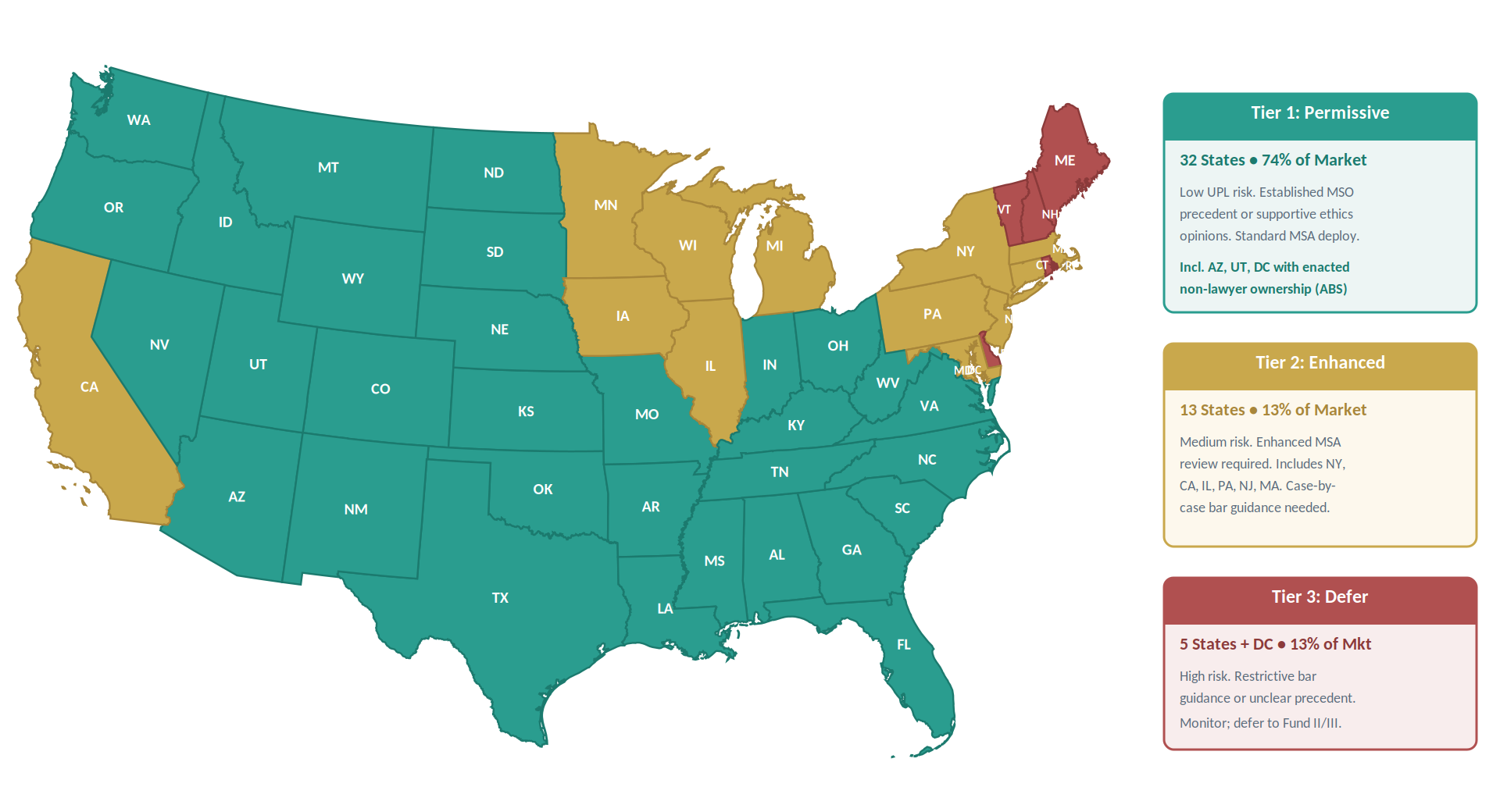
Source: ABA Model Rules, State Bar Ethics Opinions, Regulatory Filings